A portable karaoke machine review should answer whether the complete setup is easy to carry, connect and use where you plan to sing. Compare the exact machine, microphones, power arrangement and song source. A carrying handle or impressive battery headline alone does not tell you whether the whole singing kit fits your evening.
This review guide uses official documentation to compare two examples and explain what to verify yourself. It does not report personal hands-on testing or rank untested products as winners. We focus on four practical criteria: complete cost, sound checks, singing functions and connectivity. Confirm the current model and regional package before buying, because similar names can describe different products.
Start with the whole portable kit
List everything you must move: the machine, microphones, cables, charger and lyrics device. If a phone supplies songs and a tablet displays lyrics, include both in your plan. A compact speaker may still need a separate bag of accessories. The complete load matters more to your trip than the machine’s case dimensions alone.
Decide where the kit will be used and how it gets there. Moving between rooms is different from carrying it from a car or setting up at a borrowed venue. Check the actual manufacturer’s environmental and power instructions. Portable does not automatically mean waterproof, suitable for every outdoor condition or usable without another device.
Documentation example: JBL PartyBox Encore Essential 2
The official JBL — PartyBox Encore Essential 2 specification sheet lists microphone and guitar inputs, a net weight of 6.2 kilograms and music playtime of up to fifteen hours, qualified by volume and audio content. These are manufacturer specifications, not measured results from this article. The sheet’s box list does not include a microphone, so check the package you would actually purchase.
This example shows why a complete comparison needs more than the speaker price. Confirm the microphone you intend to use, how lyrics will be displayed and the source providing your songs. Do not confuse the Essential 2 with another Encore model. Ask for the exact documentation when a listing’s photographs or name leave the variant unclear.
Documentation example: Singing Machine SML640
The official Singing Machine — SML640 setup and troubleshooting describes the SML640 as a portable karaoke speaker and explains use with the Singing Machine mobile app. That makes its app and device arrangement an important comparison field. The documentation supports this setup description; it does not establish an independent sound-quality score, battery test or overall superiority.
Read the current guide for the version you are considering and confirm included accessories. Check the required phone or tablet, account access and the way songs reach the speaker. If you want to sing without an internet connection or without a particular app, investigate that requirement directly. Do not assume every portable model provides the same offline functions.
Compare carryability through concrete questions
Use the stated weight and dimensions, then consider the microphone and charger you will add. Check whether the handle or bag arrangement is documented for the equipment. If possible, inspect the grip and the space required for transport. A product photograph cannot show whether carrying the complete kit will be comfortable for you.
Record your actual observations separately from manufacturer figures. A review that has not weighed or carried the product should not invent those results. If the setup has several loose accessories, label them and plan where they will be stored. A tidy kit may answer your portability need better than a different speaker with a similar advertised size.
Read battery claims with their stated conditions
When a manufacturer gives an up-to runtime, keep the qualifications beside the number. Do not turn that figure into a promise for every singing session. Check charging instructions, whether microphones use separate batteries and how the system behaves under your intended power arrangement. The complete kit can have more than one item requiring attention.
For your own setup check, record the model, settings, connected devices and session duration. Label that as your observation rather than a universal battery result. Leave room in the event plan for the documented charging arrangement. Do not use an unapproved power supply or improvise a connection because another model supports it.
Separate speaker sound from the microphone setup
If you can try a candidate, play a familiar backing track at a comfortable level and then add the intended microphone. Check whether you can balance voice and music with the controls supplied. Keep effects modest while evaluating the basic setup. A wattage figure alone does not establish clarity in your chosen room.
Shure — How to Control Feedback in a Sound System explains the loop between a microphone and loudspeaker and discusses placement and levels. Use that guidance when checking a portable setup. A squeal can involve the arrangement and settings, so buying a more expensive microphone is not automatically the answer. Follow the product’s instructions and make one change at a time when investigating the cause.
Follow the lyrics path as well as the audio path
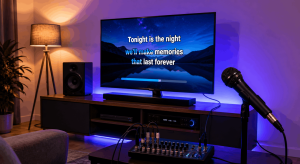
Identify which device shows the words and which produces the sound. A Bluetooth music connection does not automatically send a lyrics picture to a television. If your plan needs a separate display, confirm that route in the actual equipment and app documentation. Test the combination before assuming the portable speaker is the complete karaoke system.
Check how singers choose songs and how another person changes the queue. If a phone is doing several jobs, consider whether that is workable for your group. A built-in screen can offer a different arrangement, but it still needs supported content. Compare functions with your actual event rather than treating every extra screen as a guaranteed improvement.
Review microphone count and compatibility
For duets, confirm that both microphones can operate together with the exact machine. A microphone socket count and a wireless bundle description may answer different questions. Check receiver compatibility and independent controls where those matter. Do not assume a wireless microphone from another set will pair simply because it looks similar.
For solo singing, decide whether movement or a simpler cable arrangement matters more to you. A wired setup needs a sensible cable route; a wireless setup needs its documented receiver and power plan. Neither category is universally better. Match the choice to the source, room and singers, then verify the equipment combination rather than a generic marketing label.
Check use conditions before taking the kit outside
Read the exact environmental rating and instructions for the model. A rating should retain its stated scope; it is not permission for every wet or dusty setting. Plan where electronics, power connections and lyrics devices will sit. A portable speaker does not make an unprotected phone or cable weather resistant.
Keep drinks away from equipment and follow the manufacturer’s storage guidance after the session. If conditions exceed the documented use instructions, change the location or arrangement. Do not describe a model as an outdoor winner based solely on its handle, battery or a photograph beside a pool.
Compare complete costs at the time you shop
Add the actual seller price, microphone, required cables, carrying accessories and song-service access. Mark what is optional and what is necessary for your plan. A low unit price and a larger bundle are not directly comparable until the included parts are clear. This article supplies no current bargain ranking or fixed price tier.
Check warranty and return terms for the exact seller and version. If a critical compatibility detail is unknown, ask before ordering. Keep the official source links with your notes so you can verify a changed listing. A useful review should make those gaps visible rather than replace them with invented first-hand impressions.
Use a simple listening and setup record
NIDCD — Noise-Induced Hearing Loss explains why sound level and exposure duration matter to noise-related hearing risk. The listening information here is general education, not medical advice. Keep the session comfortable and avoid treating a loud demonstration as proof of quality. A product label or power rating does not establish a safe listening exposure.
The final portable karaoke machine review record should state the complete kit, documented features, unresolved questions and any observations you actually made. The JBL and Singing Machine examples illustrate different things to check, not tested winners. Once your songs, lyrics, microphones and power plan fit together, you have a clearer basis for choosing portable singing equipment that matches your gathering.